
Psychological thriller · A standalone novella
The Dream Woman
A Novella
Nathan Cross has grown used to being alone. Then he meets the woman of his dreams—and begins to wonder what happens when he looks away.
Enter a quiet apartment where being alone may be easier to understand than being loved.
Your first incident is free
Read or listen to Chapter One.
No signup. No excerpt cut short just as something goes wrong. The complete opening chapter is here.
Chapter One · Audio edition
Before Her
6 minutes 36 seconds · Computer narration by Qwen · Cal
Watch Chapter One
Open Chapter One on YouTube →Chapter One · Free to readBefore HerOpen chapter Close chapter
Chapter 1: Before Her
The microwave beeped three times, the same way it had every night for longer than I cared to count.
I didn’t move immediately. There was no rush. No one was waiting for dinner to be served, no conversation to return to, no warm body on the couch asking what was taking so long. Just me, and the hum of the refrigerator, and the orange glow of the streetlight bleeding through the blinds.
My name is Nathan Cross. I’m thirty-four years old. I work as a network security analyst for Cresswell Data Services. I monitor systems, patch vulnerabilities, and occasionally spend twelve-hour shifts watching logs scroll across screens while nothing happens at all. It’s exactly as exciting as it sounds.
I live alone in apartment 4B of a building that was probably nice in the 1970s. The carpet was replaced sometime during the Clinton administration. The radiator makes a sound like a dying animal every morning at 4 AM. The elevator works about seventy percent of the time, which is better odds than my dating life.
I eat dinner standing at the kitchen counter because sitting at a table for one feels more pathetic than I can bear.
The microwave beeped again—impatient now, like even the appliances were tired of my shit.
I retrieved the plastic tray. Chicken tikka masala, allegedly. The sauce had that nuclear-orange glow that nature never intended, the kind of color scientists probably use to test lab rats’ willingness to eat poison. I peeled back the film, steam rising in a sad little cloud, and grabbed a fork from the drawer.
Just one fork. I only ever needed to wash one fork.
The apartment was clean. I want to be clear about that. I wasn’t some depressive mess living in squalor. The floors were swept, the dishes done, the bed made every morning with military precision. My mother had drilled that into me before she’d gotten too sick to drill anything into anyone. A clean space is a clear mind, Nathan.
She’d said that even when her own mind was going. Even when she confused me with my father, who’d been dead since I was twelve. Even when she forgot what year it was, what decade, what century. Her apartment in the assisted living facility was always immaculate, right up until the end. The nurses said they’d never seen anything like it—a woman who couldn’t remember her own name, but who still folded her towels into perfect thirds.
I inherited her precision. I’m still not sure if that’s a gift or a curse.
But clean isn’t the same as lived-in. Clean can be sterile. Clean can be a museum of a life that’s happening somewhere else, to someone else, while you just… maintain the exhibit.
I ate standing at the counter, scrolling through my phone with my free hand. Email. News. Email. The headlines were the usual parade of catastrophes—political scandals, climate disasters, celebrity breakups. Nothing that affected me directly. Nothing that would change anything about my tomorrow.
A text from my sister Sarah: “Hey, just checking in. How are you doing? (And I mean REALLY doing, not just the Nathan version of okay.)”
I typed back: I’m good. Work is busy. Talk soon.
I wasn’t good. Work wasn’t busy. But she had her own life now—husband David, two kids whose names I could never keep straight (Tyler? Taylor? Trevor?—which said more about me than about them), a house in Connecticut with a yard that needed mowing and a mortgage that needed paying. She didn’t need to worry about her older brother turning into one of those statistics you read about. Men who die alone. Men who aren’t found for weeks because no one thinks to check.
I finished the tikka masala. The chicken was rubbery. The sauce stuck to my tongue like paste. I threw away the container, washed the fork, and put it in the drying rack.
One fork.
The couch accepted me with the familiar sigh of cushions that had learned my shape. I had a permanent indent in the left corner, the place I always sat, the grooves of my body pressed into the fabric like a fossil. Here lies Nathan Cross, I imagined the cushion saying. He sat here every night for years. He wasn’t unhappy. He just wasn’t anything at all.
I turned on the TV, flipping through channels until I landed on a documentary about deep-sea creatures. Things that lived in the dark, miles below the surface, never seeing sunlight. There was something called a barreleye fish that had evolved a transparent head so its tubular eyes could look directly upward through its own brain. Scientists said it lived alone, drifting in the eternal dark, waiting for the faint bioluminescent glow of prey.
That’s me, I thought. Floating in the dark, looking up through my own head, waiting for something to happen.
I laughed at my own joke. The sound was strange in the quiet apartment—too loud, too sudden, like dropping a glass in a library. I stopped laughing.
My phone buzzed. Work email. Server maintenance scheduled for this weekend. Did I want to take the overnight shift? Overtime pay at time-and-a-half.
I typed: Sure, happy to help.
What else was I going to do?
Sleep came in fragments that night, the way it often did.
I’d drift off during a commercial break, wake to the TV casting blue shadows across the ceiling, drift off again. Dreams came too—disjointed, forgettable. The meeting I had next Tuesday. The email I’d forgotten to send. The usual detritus of an unremarkable life.
Six months ago, my therapist had suggested travel. Dr. Levine, a kind-eyed woman in her sixties who’d helped me through the divorce and then through the aftermath of the divorce, which turned out to be worse. “Get out of your routine,” she’d said. “Book a trip. Somewhere you haven’t been.”
So I’d booked a solo trip to Mexico—two weeks of hiking, zip-lining, and aggressive self-improvement. The resort had been mediocre. The jungle tours had been crowded with honeymooners. I’d come back tanned, mosquito-bitten, and exactly the same person I was when I left.
I still had three days of unused vacation. I was saving them for something, although I couldn’t have said what.
I woke to daylight streaming through the blinds. The TV was still on—some cooking show where a chef was enthusiastically deboning a fish. A dull headache pulsed behind my right eye. Probably the sodium in the tikka masala. Too much screen time. The usual.
I took two aspirin, showered, and stared at my reflection in the mirror—pale skin, dark circles under my eyes, the kind of face that disappeared in crowds.
Same as yesterday. Same as tomorrow.
I got dressed and headed to the coffee shop.
The story
One impossible detail is enough.
Nathan Cross fills his evenings with microwave dinners, work emails and television. His life is orderly, solitary, and going nowhere.
Then a chance meeting changes everything. The connection feels impossible to question—until the small things he cannot explain begin to accumulate.
Read on AmazonDo not miss the next incident
Join Julian's reader list.
Occasional release notes and unsettling extras. No daily noise.
Another door
If this one lets you go…
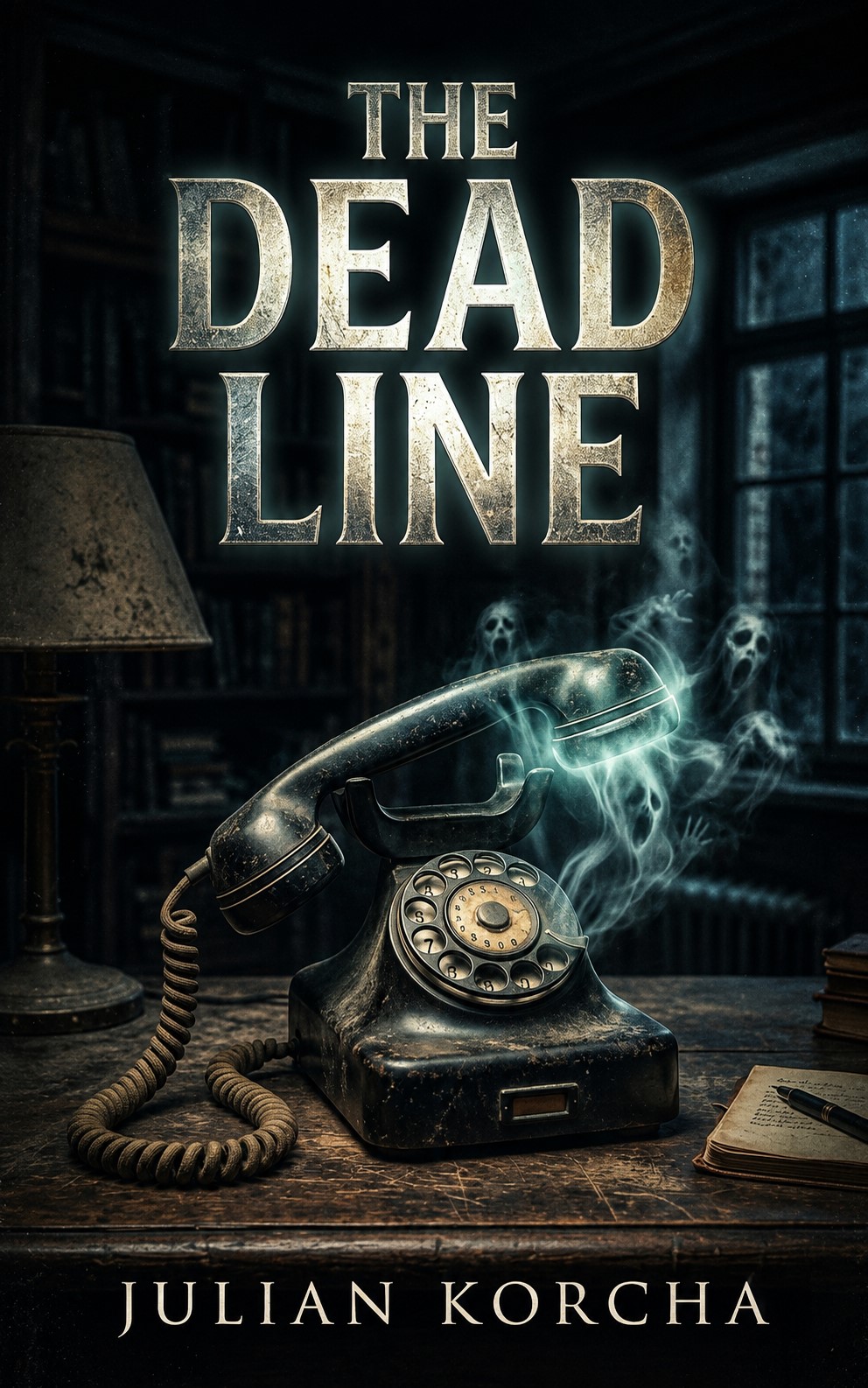
Supernatural horror · A one-evening novella
The Dead Line
Emily Vance buys an old rotary phone at an estate sale. With no phone line connected, it rings. The caller is dead.